The Founders of 1787
The subscription notice that founded cricket at Cox-Heath and Linton — and the roll of gentlemen who put their names to it.
Where the club begins
Framed in the pavilion hangs the club’s oldest treasure: the original printed notice calling a Cricket Meeting at Cox-Heath, to begin in 1787. Cox-Heath, a mile or two from our ground, was one of the great cricketing commons of Georgian Kent, and the meeting was subscribed by the leading gentlemen of the county — among them the two most famous patrons in the history of the early game, and the squires of Linton Park itself. The club it founded was the Coxheath Cricketing Society, which in time became Linton Park Cricket Club — so this notice is, in effect, our first constitution, and our founding year is 1787.
The notice
To meet once a week, except in those weeks when a great County Match is to be played, of which notice will be given on the meeting previous to it, for the encouragement of the best players to come, to chuse as equal a Match as possible for one innings.
To allow five shillings for the Winners, and two shillings and sixpence for the Loosers, to pay all expences of horse hire, &c. To allow one shilling each man for eating, and sixpence for his drink.
An Ordinary to be provided at two shillings for Subscribers, and three shillings Non-Subscribers. The wine, &c. to be paid for exclusively.
☞ No forfeits of any kind for non-attendance.
Transcribed from the original notice. The long-form “ſ” of the period is set in modern letters, but the spellings of the day — chuse, Loosers, expences — are kept as printed.
The roll of subscribers
The gentlemen who subscribed two guineas a year to the meeting, in the two columns of the original notice:
- His Grace the Duke of DorsetJohn Frederick Sackville, 3rd Duke of Dorset — one of the greatest patrons of the Georgian game
- Sir Horace Mann, Bart.Sir Horatio Mann of Linton Park (1744–1814), the celebrated patron of Kent cricket
- The Rev. Jacob Marsham
- Edward Hussey, Esq.
- The Rev. William Hussey
- James Mann, Esq.of the Mann family of Linton Park
- M. Austen, Esq.
- T. Borrett, Esq.
- W. D. Douce, Esq.
- John Brenchley, Esq.
- Mr. Amhurst
- Mr. Stephen Amhurst
- Mr. Walter Prentis
- Mr. George Taylor
- Mr. Stacey
- Mr. Strain Stevenson
- Mr. William Turner
- Mr. Robert Stevenson
- Hon. Charles Marsham, M.P.later 1st Earl of Romney
- Filmer Honeywood, Esq., M.P.
- Clement Taylor, Esq., M.P.
- Sir John Brewer Davis
- J. Cole, Esq.
- T. Turner, Esq.
- A. H. Shove, Esq.
- N. Graham, Esq.
- G. Gunnings, Esq.
- T. Martin, Esq.
- Mr. Stanford
- Mr. Richard Hosner
- Mr. James Smyth
- Mr. James Taylor
- Mr. L. Taylor
- Mr. John Seager
- Mr. John Blake
The names that matter
His Grace the Duke of Dorset and Sir Horace Mann head the roll — between them the two foremost patrons of eighteenth-century cricket, who staged and wagered on the great matches of the age. Sir Horace — Sir Horatio Mann of Linton Park — and James Mann tie the meeting directly to our own ground: the Mann family were the squires of Linton Park, beneath whose great house the club has played ever since. And it was this same Sir Horatio Mann who, in the very year of our founding, helped to establish the Marylebone Cricket Club — so Linton Park shares its birth-year, 1787, with the MCC itself. The Marshams, Husseys, Honeywoods and Taylors beside them were the landed families of the Weald, several of their names — Brenchley, Prentis, Amhurst — still worn by Kent villages today.
Our own scorecards begin only in 1860, and the years between are not ours to fill with detail we do not hold. But this notice is the thread that runs back through them all — proof that gentlemen were chusing as equal a match as possible, here on the edge of Cox-Heath, nearly two and a half centuries ago.
Down the years
The Coxheath Cricketing Society kept its meeting going down the generations. Its cricket was played on Coxheath Common and at the Star Inn, which stood opposite Linton Park at the crossroads of the present A229 and B2163; as late as 1833 the “Gentlemen of the Coxheath club” were still meeting there to play — against Hadlow that June, wickets pitched at ten o’clock and a “good ordinary” to follow, the very dinner named in the 1787 notice. A century and a half on, in 1937, the club marked its 150th with a “local Derby” against Tovil CC — a side our own scorebook still remembers: J Pocock, A Pratt, C Thomsett, O Fryer, R Harper and N Judge; P Brattle, A Buckoke, F Sutton (captain), E Cheeseman and A Ash; with N Hawkes scoring. And those who knew the ground between the wars recalled how beautifully it was kept: groundsman Bill Farley mowed and rolled it behind a horse shod in leather shoes to spare the turf, and on Easter Mondays there were flower shows before the cricket.
From the archive
A few of the oldest photographs the club holds — dated by dress where no year survives on the print:
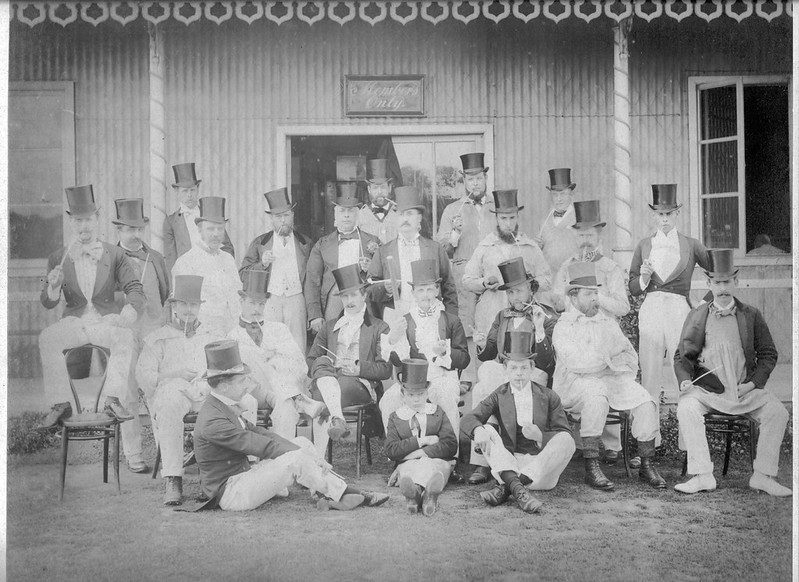
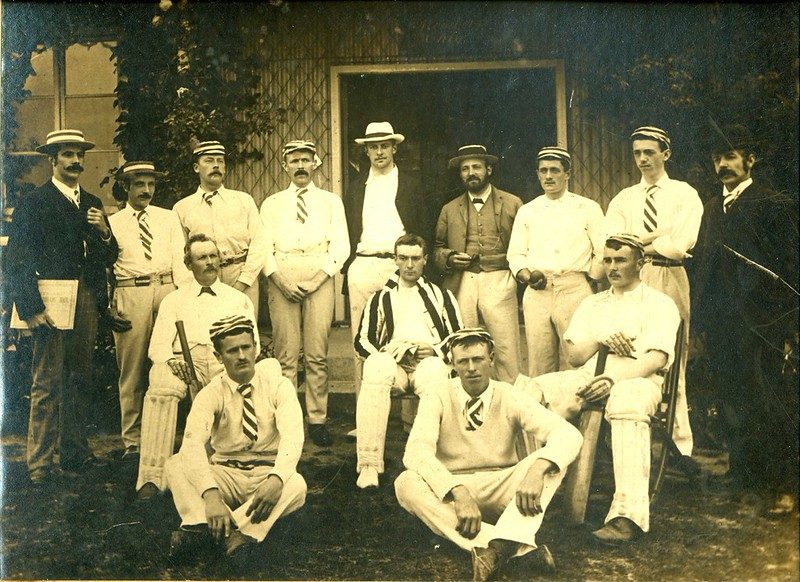
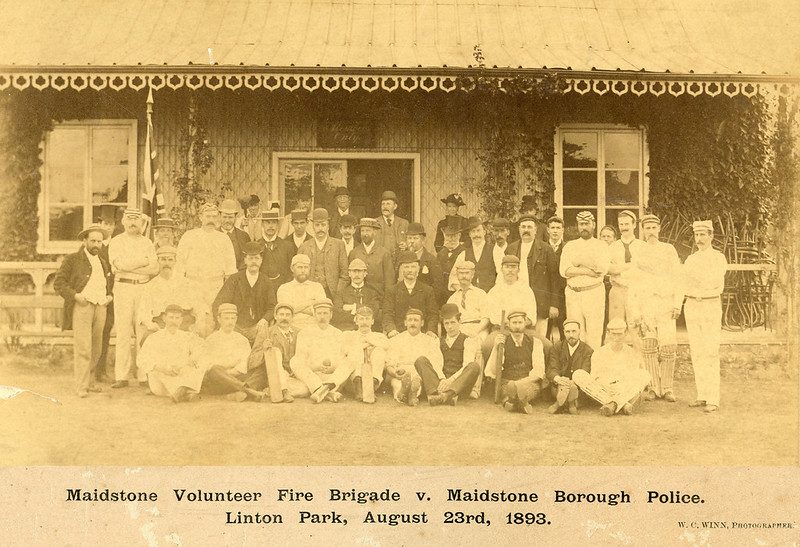
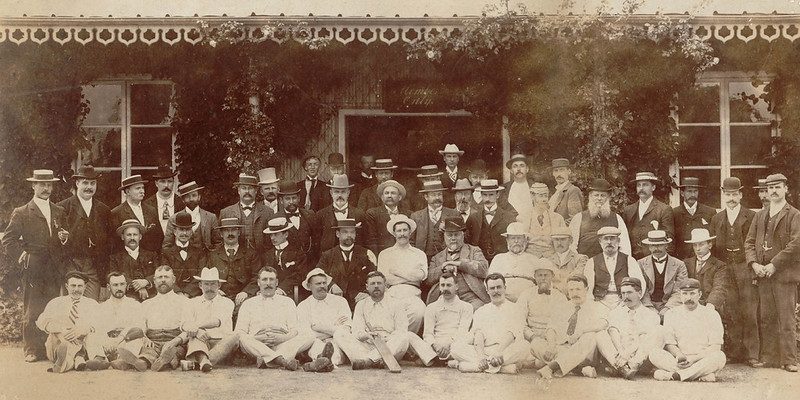
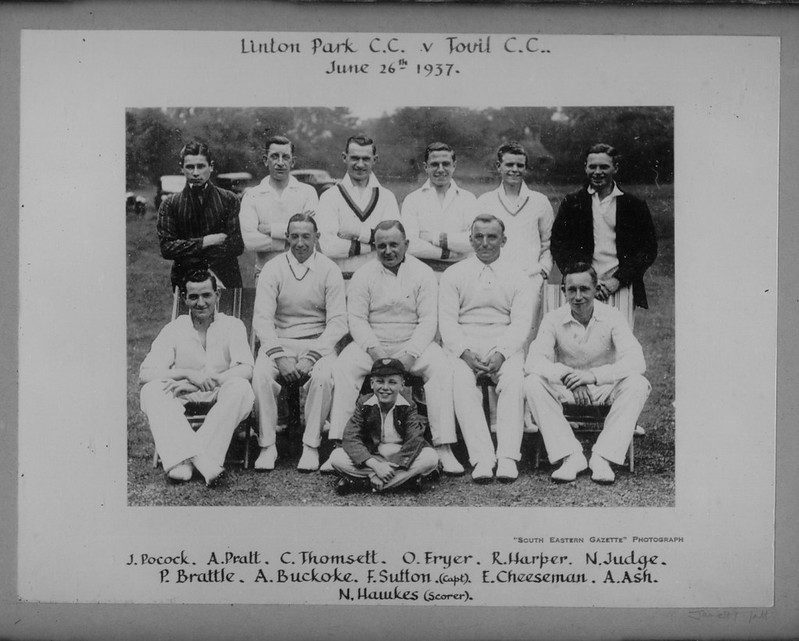
Historical detail from the Loose Area History Society — Loose Threads Nos. 12 & 14, with thanks to Derek Pantony. The Star Inn and the 1833 fixture are from the Dover-Kent Archives (Maidstone & Kentish Journal, 18 June 1833). See also the Estate, for the Manns and Cornwallises of Linton Park, and the Roll of Honour.