
Linton Park — The Estate
The Grade I listed country house and historic parkland the club has played beneath since 1861 — one of the loveliest settings in Kent cricket.
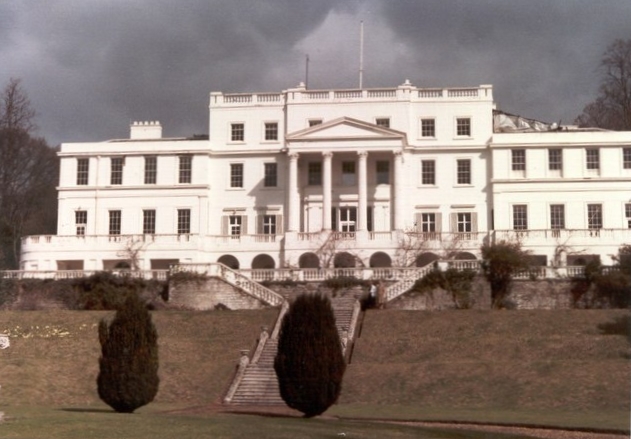
Photograph via Wikimedia Commons (geograph.org.uk), CC BY-SA 2.0
The house
A house has stood on this spot since the late 14th century, when the site was held by a medieval hall known as Capell’s Court. The present mansion was begun around 1730 by Robert Mann — a two-storey brick house that was transformed in 1825, when the celebrated builders Thomas and William Cubitt enlarged it for the fifth Earl Cornwallis, raising a third storey, adding side wings and refacing the old brickwork in white stucco. Its south front — the face that looks down over the garden and the cricket — is the grandest of all: a long arcade with a balustrade above, crowned by an imposing portico of four giant Corinthian columns. The house is listed Grade I.
The Manns & the Cornwallises
The Mann family came from Suffolk and first put down roots in Kent when they bought Linton Place in 1724; Robert Mann built the present house soon after. Across the 18th century the Manns assembled a compact estate through the Weald — centred on Linton, Egerton and Cranbrook — which passed from Edward Louisa Mann to his brother Sir Horatio and then to their nephew Sir Horace Mann (1744–1814) — better known to cricket history as Sir Horatio Mann, one of the greatest patrons of the Georgian game, who staged matches for huge stakes on his Kent estates.
The link to the Cornwallis family came through marriage: Catherine Mann married James Cornwallis, Bishop of Lichfield and Coventry, who became the 4th Earl Cornwallis. Their son James took the name Mann by royal licence in 1814 under the terms of a family will, inherited the Linton estates, and in 1824 succeeded as the 5th Earl Cornwallis — the earl who enlarged the great house the following year. It was this Cornwallis family who built the cricket club’s pavilion in the 1880s, and the estate later passed down the female line to the present branch. In the 20th century the house was home to the Hambro banking family (1937–1961) and the Daubeny family, and since 1985 it has belonged to the Camellia group.
The gardens & park
The house sits at the heart of some 132 hectares of parkland, woodland and farmland on a south-facing slope, with sweeping views over the River Beult valley and the Weald of Kent. The formal gardens were laid out in 1825 by the great landscape gardener John Claudius Loudon and still feature terraces, garden temples, an avenue of giant sequoias and a Gothic folly; the gardens and park are listed Grade II*, with the stables and ice house Grade II.
The Linton Beagles
For close on half a century the Cornwallises kept a celebrated foot-pack of beagles at Linton. Mr F. S. W. Cornwallis — later the 1st Baron Cornwallis — was their Master from 1886, and the pack was well enough known to feature in British Sports and Sportsmen: Hunting in 1912 as “The Linton Beagles, Mr F. S. W. Cornwallis, Master”. The hounds were kept by Bill Guess and hunted the hares over the Linton country. They met for the last time on 9 March 1932, here at Linton Park, when members of the hunt made a presentation to Lord Cornwallis and the pack moved off led by him and his son, Captain the Hon. Wykeham Stanley Cornwallis. A photograph of the Linton Beagles’ cricket match still hangs in the pavilion — a reminder that the hunt and the cricket club shared the same great house and the same summer field.
Cricket beneath the great house
It is beneath this house, on ground given to the game since 1861, that Linton Park has played its cricket for generations — the great mansion looking down over the boundary, and the Weald falling away beyond. There are few grander places to watch a village game.
Historical details summarised from the Linton Park article on Wikipedia. Historical detail from the Loose Area History Society — Loose Threads Nos. 12 & 14, with thanks to Derek Pantony.